
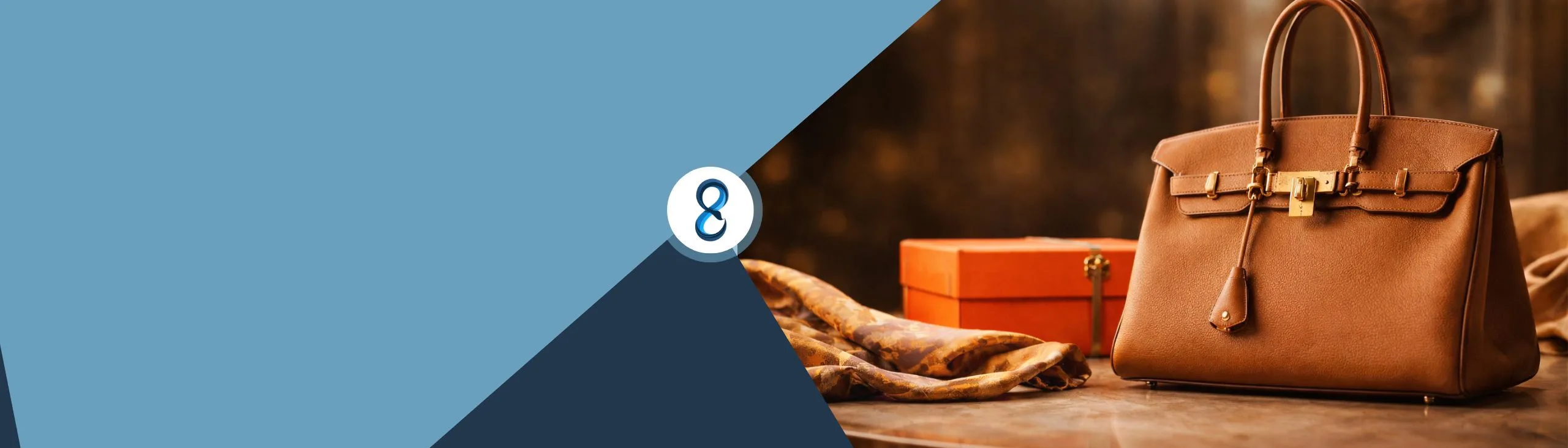
In traditional marketing, success is often measured by a very simple logic: sell more. More production. More distribution. More customers.
Most companies grow by trying to expand the market and make their products increasingly accessible.
Hermès has chosen a completely different path. The French brand has built its success not on accessibility, but on deliberate rarity.
It doesn’t try to sell as much as possible. It tries to be hard to get. In an age dominated by speed and instant availability, Hermès has built its legend on an almost counterintuitive principle: slow down. Limited production. Controlled distribution. Waiting.
And it is precisely this strategy that has transformed some of its products into almost mythological objects.
In the world of contemporary luxury, Hermès represents one of the most fascinating examples of marketing based on scarcity.
1. The Origin: When Luxury Is Born from Craftsmanship
Hermès was founded in 1837 in Paris as a saddlery workshop for horses. Founder Thierry Hermès created harnesses and accessories for the European aristocracy, who at the time considered horse riding a symbol of social prestige.
From the beginning, the brand built its reputation on three fundamental elements:
excellent craftsmanship
excellent materials
Handcrafted
Each product is designed to last. They are not simply functional objects, but artifacts that reflect a culture of craftsmanship. When the automobile replaced the horse as a symbol of mobility and status in the twentieth century, Hermès underwent a delicate transformation. Many brands associated with equestrianism disappear.
Hermès, however, makes a smart strategic choice: it transfers its know-how to new products.
This gives rise to lines of:
leather goods
bags
accessories
silk scarves
The principle, however, remains the same. Production must not grow too quickly. Luxury must not become ordinary. Rarity becomes part of the brand’s value.
2. The Birkin Bag: When a Product Becomes Legend
In 1984, an event occurred that has become almost mythical in the history of the brand. Jean-Louis Dumas, then CEO of Hermès, found himself on a flight next to actress Jane Birkin. During the flight, Birkin recounted that she couldn’t find a bag that was elegant yet roomy enough for everyday use. She needed something that was both practical and refined. Dumas took a piece of paper and drew a sketch. From that conversation the Birkin Bag was born.
The bag combines functional and aesthetic elements:
generous size
highest quality leather
robust construction
elegant yet discreet design
Over time, the Birkin has become one of the most iconic luxury items. Today, some rare versions, made with exotic leathers or with precious metal details, can easily exceed €100,000. But the real distinguishing feature isn’t the price. It’s the difficulty of buying it.
3. The paradox of the impossible purchase
Unlike most luxury products, the Birkin isn’t on the shelves of boutiques. You don’t just walk into a store and buy it. Often, the opposite happens.
The customer must:
build a relationship with the boutique
become a repeat customer
Buy more products
Wait for a bag to be offered.
This system has never been officially declared by the company, but it has become an integral part of the Hermès myth. The bag isn’t simply sold. It’s offered.
This completely reverses the purchasing dynamic. The customer is no longer just a consumer. They become someone who aspires to obtain the object. From a psychological standpoint, this mechanism produces a very powerful effect. It transforms the purchase into an achievement.
4. Scarcity as a Strategy
Many brands try to simulate scarcity through limited editions or seasonal collections. Hermès takes a more radical approach.
It maintains deliberately slow production. Each bag is made by a single artisan who oversees the entire production process.
This method guarantees:
absolute quality control
artisanal consistency
Limited production
Making a bag can take between 15 and 20 hours of work. The artisan who produces it adds an identification code that allows the workshop to be traced back to the original maker. This detail reinforces the perception of uniqueness.
Scarcity, therefore, is not just a marketing strategy. It is a consequence of the production method. And it is precisely this combination of craftsmanship and limited availability that fuels desire. In economics, this phenomenon is known as the scarcity effect. When something is rare, its perceived value increases.
5. The Secondary Market: When Luxury Becomes an Investment
One of the most surprising aspects of the Hermès case concerns the secondary market. Many luxury products lose value once purchased. Hermès bags often do the opposite. Some models, particularly Birkin and Kelly, can increase in value over time.
In some cases, they have outperformed traditional assets such as:
gold
stock indices
high-end real estate
This phenomenon has transformed some Hermès bags into true investment objects. International auction houses like Christie’s and Sotheby’s sell rare models for extraordinary prices. This further strengthens the brand’s myth. When a product also becomes a collectible asset, desire grows.
6. Hermès’ anti-marketing
Another fascinating aspect of the brand is its almost detached relationship with traditional marketing. Hermès does not employ many of the aggressive strategies typical of global brands.
It does not focus on:
massive advertising campaigns
continuous celebrity endorsements
noisy marketing
The brand communication is discreet. Elegant. Consistent with the cultural world of luxury.
The brand prefers to build prestige through:
tradition
craftsmanship
- cultural reputation
Much of its success comes from social word-of-mouth. Those who own a Birkin or Kelly bag tell others about their experience. In this way, the customer becomes a spontaneous ambassador for the brand.
7. Marketing Lessons from the Hermès Case
The Hermès case holds some very interesting lessons for marketers.
Scarcity can be more powerful than availability
In a market saturated with products, rarity increases desire. Not everything needs to be easily accessible.
The process can become storytelling
The fact that a bag is made by a single artisan becomes part of the brand’s narrative. The production process becomes content.
The experience can be as valuable as the product
The difficulty of buying a Birkin turns the purchase into a personal story. The customer doesn’t just buy an object. They buy an experience.
Luxury is symbolic
In the luxury market, value isn’t just functional. It’s cultural and social. An object becomes powerful when it represents something greater than the product itself.
Conclusion
Hermès doesn’t simply sell bags. It sells access to a symbol. The Birkin isn’t just a fashion item. It’s a story. An achievement. A social signal.
In a world dominated by instant availability and e-commerce, Hermès has built its empire on an opposite principle:
What is difficult to obtain becomes irresistible. And it is precisely this tension between desire and rarity that continues to fuel the brand’s myth. Because in luxury, more than in price, the value often lies in one thing: the feeling of owning something that not everyone can have.
Servizi correlati Ottobix